

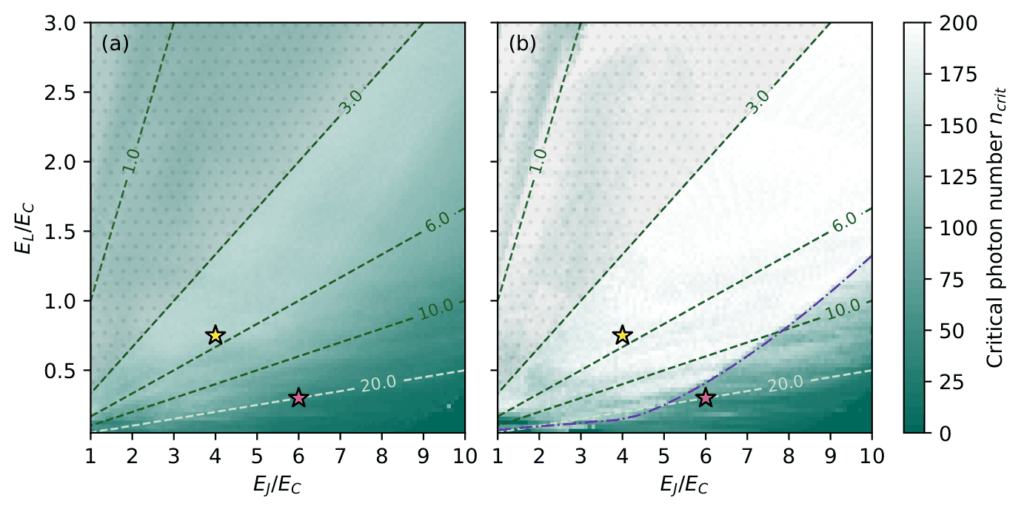
Fluxonium qubits are gaining attention as a promising alternative to transmon qubits, thanks to their long coherence times and their ability to support fast, high-fidelity quantum gates. However, one aspect that has remained less clear is how well these qubits can be read out.
In transmon systems, recent studies have identified measurement-induced state transitions as a leading source of readout error. For fluxonium qubits, though, the role of these effects has not been fully understood. In this work, we take a systematic approach to this question, exploring a wide range of fluxonium designs that cover essentially all experimentally relevant regimes.
We find that “lighter” fluxonium variants are generally less susceptible to these readout-induced transitions, and we identify the key physical mechanisms responsible for this behavior. Together, these results provide a clearer picture of the limitations of fluxonium readout and offer practical guidance for the design of future fluxonium-based superconducting quantum processors.